In this guide
- The key points
- Key terms, in plain words
- What changed on 9 October 2026, and what did not
- Panama: from permit to tax residence
- Costa Rica: territorial, with a health levy
- Uruguay: the eleven-year holiday
- The three, side by side
- Why the certificate matters more than the permit
- If you live in Germany: what the tax office checks
- If you live in Romania: what ANAF checks
- And Cyprus? The combination many choose
- How we do it: the order of steps
- The most common mistakes
- Three illustrations
- The circle you join
- FAQ
- Next steps
- Sources
Status as of 30 October 2026: based on the conclusions of the Council of the EU of 9 October 2026 revising the EU list of non-cooperative jurisdictions for tax purposes, Article 762-N of Panama's Fiscal Code and the published requirements of Panama's Dirección General de Ingresos (DGI) for the tax residence certificate, Panama's migration rules as summarised in our Plan B guide on Panama, Costa Rica's Income Tax Law 7092 and its regulation, the rules of the Caja Costarricense de Seguro Social (CCSS), Costa Rica's General Law on Migration 8764, Uruguay's Law 20.446 of December 2025 and Res. DGI 2158/2026 and the guidance of Uruguay's Dirección General Impositiva (DGI) on the regime for new tax residents, and the German and Romanian rules cited below. Official fees and thresholds are stated as of October 2026. We will update this guide when the rules change.
At the Miraflores locks, a ship the length of three football pitches waits in a concrete chamber while water pours in beneath it. Slowly, without a sound you can hear from the viewing deck, it rises. The gates open, and it slides on toward the lake and the other ocean. Nobody on the deck applauds, but everybody watches. There is something about seeing a heavy thing lifted by a simple, well-designed system that makes people quiet.
That is the promise of a second residence in Latin America for a European family. Not escape, not a beach postcard, but a system that lifts. A residence permit that lets you live somewhere the state asks less of you. A tax residence that, if you build it properly, changes what you owe and to whom. For decades, the families who had this were the ones with a lawyer in Panama City, a banker in Montevideo and an accountant who understood both. Until now only the rich could. Now you can too, with ENCC.
This month, one piece of the picture moved. On 9 October 2026, EU finance ministers took Panama off the EU blacklist of non-cooperative tax jurisdictions and placed it on the watch list. Headlines followed. And so did a confusion we hear every week: if Panama is off the list, can I become tax resident there with a permit and a property? This guide answers that question honestly. It explains what changed and what did not, what Panama really requires for a tax residence certificate, and how two neighbours compare: Costa Rica, territorial but with a health contribution that surprises many, and Uruguay, with a new eleven-year holiday on foreign investment income for new residents. Then we show how we build the plan, and why for many of our readers the answer is a Latin American permit combined with a tax home in Cyprus.
The key points
- Panama is off the blacklist, on the watch list. On 9 October 2026 the Council of the EU removed Panama from Annex I of the EU list, where it had been since February 2020, and moved it to Annex II pending a new OECD review of how Panama exchanges tax information on request. The next update is due in February 2027.
- A residence permit is not tax residence. In Panama, tax residence requires more than 183 days in the tax year or the year before, or a permanent home there. The tax residence certificate is applied for at the DGI with proof of your days, your home and your ties.
- Panama taxes territorially. As a rule, income from outside Panama falls outside its income tax. But your home country applies its own tests regardless.
- Costa Rica is territorial too, with a health levy. Residents in the main categories must join the national social security fund, the CCSS, and pay monthly contributions based on declared income. A bill to tax foreign passive income of residents is in parliament, not in force.
- Uruguay offers an eleven-year holiday. Under Law 20.446, people who become tax resident from 2026 can opt to keep foreign dividends and interest outside Uruguay's personal income tax for the year of arrival and the ten following years, under conditions.
- Your old country decides first. Germany's § 2 and § 6 of the Foreign Tax Act and Romania's residence rules apply before and after the move. Germany has tax treaties with Uruguay and Costa Rica, not with Panama.
Key terms, in plain words
Residence permit. Permission from the migration authority to live in a country. It says nothing about taxes.
Tax residence. The status that decides which country may tax your worldwide income, or at least your income from that country. It depends on days, home and ties, not on the card in your wallet.
Tax residence certificate. A document from the tax authority confirming that you are tax resident there for a given year. Banks, other tax offices and treaty claims rely on it.
Territorial taxation. A system that taxes income from sources in the country and, as a rule, leaves foreign income outside the income tax.
Annex I and Annex II. The EU list of non-cooperative jurisdictions for tax purposes is Annex I, the so-called blacklist. Annex II is a separate state of play of cooperative jurisdictions that still have open commitments, often called the watch list.
CCSS. The Caja Costarricense de Seguro Social, Costa Rica's public health and pension fund.
IRPF and IRNR. Uruguay's personal income tax for residents and its income tax for non-residents. The new holiday lets new residents be taxed under IRNR rules on foreign capital income, which in practice keeps that income outside Uruguayan tax.
What changed on 9 October 2026, and what did not
Panama is no longer a blacklisted jurisdiction. That changes how EU states treat Panamanian companies and payments; it does not make anyone tax resident. The Council's conclusions of 9 October 2026 removed Panama and Viet Nam from Annex I. According to the European Commission, this followed significant steps taken to address outstanding issues. Both were moved to Annex II pending an in-depth review by the OECD Global Forum of how they exchange tax information. Annex I now lists eight jurisdictions: American Samoa, Anguilla, Guam, Palau, Russia, the Turks and Caicos Islands, the US Virgin Islands and Vanuatu. Annex II lists ten, including Panama.
What this means in practice:
- For companies and payments. EU states apply defensive measures to Annex I jurisdictions: higher withholding, non-deduction, stricter controlled company rules. Leaving Annex I removes the basis for those measures over time. Some states key their rules to the version of the list published in the EU Official Journal, and some to the list as it stood in the previous year. Until the revised list is published and your adviser confirms how your state applies it, we treat payments to related Panamanian companies with caution.
- For you as a person. Nothing about your own tax residence changes. Your home country still decides whether you have left, and Panama still decides whether you have arrived.
- For banks. Being removed from the blacklist helps how European banks see Panamanian counterparties, but Annex II means Panama remains under observation. A bank will still ask where you are tax resident and for proof.
- For the future. The outcome of the OECD review decides the next step. The next update of the EU list is due in February 2027.
Panama: from permit to tax residence
In Panama, the permit opens the door; the days and the home make you resident. Panama has three realistic residence routes for European families, which we cover in detail in our guide on Panama as a Plan B residence:
- Friendly Nations. For nationals of the countries listed in the decree, among them Germany, Austria, the Netherlands, the United Kingdom, Ireland and Cyprus, with an economic tie such as property of at least USD 200,000 or a three-year deposit of the same amount, or a local job. Romania and Bulgaria do not appear on the versions of the list we have seen; we confirm the current decree for each case. Two years provisional, then permanent.
- Qualified Investor. Permanent residence directly, from USD 300,000 for a new property bought from the developer, with higher amounts for resale property, securities and bank deposits.
- Pensionado. For a lifetime pension of at least USD 1,000 a month, with lower thresholds if you also own Panamanian property.
Then comes the tax question. Under Article 762-N of Panama's Fiscal Code, an individual is tax resident in Panama if he stays there for more than 183 days, continuously or not, in the tax year or in the year immediately before it, or if he has his permanent home there. In practice the DGI looks at habitual use of the home and at your economic and family interests in Panama, as its own form shows; a flat you rarely use is weak evidence.
The certificate is a file, not a formality. For individuals, the DGI's international treaties department works from a sworn declaration in which you state, among other things:
- who you are and where you live in Panama: passport number and full Panamanian address;
- what you do in Panama;
- why you need the certificate: to claim a tax treaty with a named country, or for another purpose and the institution asking for it;
- the legal ground, with evidence attached: presence of more than 183 days, a habitual home, economic interests or family interests in Panama;
- the tax year concerned, with a separate form for each year.
On top of this, a certificate of your migration movements from Panama's migration service, showing your entries and exits, has been required since a DGI resolution of 2022. The form warns that the declaration is subject to verification.
The application is filed through the DGI's online system. Plan for it to take time, and keep every boarding pass.
The territorial rule has limits. Panamanian income of individuals is taxed at progressive rates, with the first USD 11,000 a year exempt, then 15%, and 25% above USD 50,000. Foreign income stays outside Panama's income tax as a rule. From 2027, Law 526 of 2026 asks companies in multinational groups to show real substance in Panama to keep that treatment for foreign passive income. None of this changes what your home country taxes.
What Panama gives a European family that does the work. A territorial system, a dollar economy, a large international banking centre and a residence that, for Friendly Nations nationals, costs less than most European golden visas did. What it asks in return is presence. More than half the year, or a real centre of life.
A permit is a door. A tax residence is a home.
We build both, in the right order, for your family.
Tell us your nationality, where you live today, how many days a year you can really spend abroad and what income you have. We show which country fits, what it takes to be tax resident there and what your home country does when you leave.
I want my structure → Or start with the Plan B form
We coordinate; legal, banking and tax services are provided by independent licensed partners in their own name and under their own responsibility. This guide is general information, not tax or legal advice.
Costa Rica: territorial, with a health levy
Costa Rica gives you a green, stable democracy without an army, a territorial income tax and a public health system you are required to pay into. It is a country many Europeans fall in love with on holiday, and one where the paperwork rewards patience.
The residence routes. Under Costa Rica's General Law on Migration 8764 and its regulations, the main categories for people who do not work locally are:
- Pensionado. A permanent and stable pension from abroad of at least USD 1,000 a month.
- Rentista. A permanent and stable income of at least USD 2,500 a month, secured for at least two years. According to recent regulatory changes reported in Costa Rica, a bank deposit returned in monthly instalments no longer counts as such income; we confirm the current practice with a Costa Rican lawyer for each case.
- Inversionista. For people who invest in Costa Rica in the forms and amounts set by the regulations.
- Digital nomads. Law 10008 created a special stay for remote workers. It is a temporary stay, not residence, and it does not by itself give you a tax residence certificate.
Spouses and children can usually be included as dependants.
The health levy. Residents in the pensionado, rentista and inversionista categories must join the CCSS and keep their affiliation current; the migration authority checks it when the permit is renewed. As a voluntary insured person or self-employed contributor, you pay a monthly contribution calculated on the income you declare, on a scale published by the CCSS. For a family with a solid foreign income, this is a real fixed cost. In return, you have access to the public system, and many residents add private insurance on top.
Tax residence. Costa Rica treats an individual as tax resident if he stays in the country for more than 183 days in the tax period, continuously or not. Sporadic absences of up to 30 consecutive days count as days in the country; longer absences do not. The tax authority can check your migration record.
The tax rule. Costa Rica taxes income from Costa Rican sources. Foreign income of residents falls outside its income tax as a rule. A bill to change this, Expediente 25.796, would bring certain foreign passive income of residents into tax. As of October 2026 it is still in parliamentary committee and not in force. We follow it, and we tell you if it moves.
What Costa Rica asks in return. More than 183 days if you want its tax residence, a monthly health contribution, and patience with a migration system that can take many months. What it gives you is a country that many families describe as the closest thing to a quiet, ordinary life in Latin America.
Uruguay: the eleven-year holiday
Uruguay is the Switzerland of South America in temperament: stable, lawful, a little conservative. And since 2026, unusually generous to new residents with foreign capital.
Tax residence. Uruguay's DGI treats an individual as tax resident if:
- he stays in Uruguay for more than 183 days in the calendar year, with sporadic absences of up to 30 consecutive days counted as days in the country;
- his centre of vital interests is in Uruguay, for example because his spouse and minor children live there and he is not legally separated;
- his base of activities or economic interests is in Uruguay, directly or through entities; or
- he has made a qualifying investment. Under the general rules, real estate worth more than UI 15,000,000, or more than UI 3,500,000 for property acquired from 1 July 2020 combined with at least 60 days of presence in the year, among other options.
UI is the unidad indexada, an inflation-indexed unit published by Uruguay's National Statistics Institute; amounts in it move every day, so we convert them at the time of your plan.
The new holiday. Law 20.446 of December 2025 created a regime for people who become tax resident from 1 January 2026. They can opt to have their foreign capital income, such as dividends, interest and rents from abroad, and their gains on foreign assets taxed under the non-resident income tax rules, which in practice keeps that income outside Uruguayan tax, for the year they become resident and the ten following years. The main conditions, according to the DGI:
- New arrival. You became tax resident from 1 January 2026, you were not Uruguayan tax resident in the two tax years immediately before, and you have not already opted for one of the holiday regimes in force until 31 December 2025.
- Presence or investment. If you are resident because you spend more than 183 days a year in Uruguay, proven each year with a tax residence certificate, no investment is required. If you are resident on another ground, you need either Uruguayan real estate worth more than UI 12,500,000, acquired from 1 September 2025, or yearly contributions of at least UI 625,000 to qualifying investment funds for productive projects or research.
- One year at a time. If you fail a condition in a given year, you lose the benefit for that year only, and you can resume it within the eleven-year window once you comply again.
The option covers foreign capital income, such as interest, dividends and rents from abroad, and gains on assets located abroad. It is made once, by a declaration to the DGI. What happens after the eleventh year is something we plan with your Uruguayan adviser from the start.
People who became resident before 2026 have their own transitional choices, and the DGI has published separate guidance for them; if that is you, we check your deadline first.
Treaties. Uruguay has double tax treaties with Germany and with Romania. That matters for anyone who keeps income or assets at home.
What Uruguay asks in return. Real presence or a serious investment, a careful first year, and an honest break with the old residence. What it gives you is a decade of calm for your foreign investment income, in a country where contracts are respected.
The three, side by side
Three countries, three philosophies. We choose together with you.
- Panama. Best for: nationals of Friendly Nations countries who want a dollar economy and a quick permit. Permit: from USD 200,000 in property or deposit for Friendly Nations, from USD 300,000 for Qualified Investor, or a USD 1,000 pension. Tax residence: more than 183 days or a permanent home, proven with a migration record. Tax on foreign income: outside income tax as a rule. EU list: off the blacklist, on the watch list.
- Costa Rica. Best for: retirees and families with stable foreign income who want to live there for most of the year. Permit: USD 1,000 pension, USD 2,500 monthly income for rentistas, or investment. Tax residence: more than 183 days. Tax on foreign income: outside income tax as a rule, with a pending bill. Fixed cost: monthly CCSS contribution.
- Uruguay. Best for: investors with significant foreign dividends and interest who are ready to spend more than half the year there or invest. Tax residence: 183 days, centre of interests or qualifying investment. Tax on foreign capital income: outside Uruguayan tax for eleven years under the new regime, if you opt in and meet the conditions. Treaties: with Germany and Romania.
Why the certificate matters more than the permit
Your bank does not ask which permits you hold. It asks where you are tax resident, and for proof. Under the OECD Common Reporting Standard, banks report your accounts to the country you declare as your tax residence. If you declare Panama, Costa Rica or Uruguay, the bank may ask for a tax residence certificate. If you cannot produce one, the bank may report you to the country of your passport or your last address, which is often the country you thought you had left.
Your old country asks the same question from the other side. It wants to know whether you have really gone and where you now live. A certificate from your new country, backed by a migration record, a lease and real life, is the strongest answer you can give. A permit without days is not.
If you live in Germany: what the tax office checks
Germany first asks whether you have left, then whether it can still follow you. The points we review with your German adviser:
- Home and habitual abode. A home you keep available in Germany under § 8 of the Fiscal Code, or a habitual abode under § 9, keeps you subject to unlimited German tax.
- Exit tax under § 6 AStG. If you hold at least 1% in a corporation and were subject to unlimited tax for at least seven of the last twelve years, the move is treated as a sale of the shares. The tax can be paid in seven annual instalments on application, usually against security.
- Extended limited tax liability under § 2 AStG. German citizens who were subject to unlimited tax for at least five of the last ten years, move to a low-tax country and keep essential economic interests in Germany can remain subject to extended German tax for up to ten years. A territorial system or a holiday on foreign income can make a country low taxed in this sense. We check this for your case before you go.
- Treaties. Germany has a double tax treaty with Uruguay, applicable since 2012, and with Costa Rica, applicable since 2017. It has no income tax treaty with Panama, only an agreement on shipping and air transport. Without a treaty, there is no tie-breaker if both countries claim you.
If you live in Romania: what ANAF checks
ANAF asks whether you have really left, and it looks at your days, your family and your interests. The points we review with your Romanian adviser:
- Residence. Domicile in Romania, the centre of vital interests or more than 183 days within twelve months keep you Romanian tax resident, and Romania taxes residents on worldwide income. Dividends are taxed at 16% from 2026, and CASS can apply above the legal thresholds.
- The departure form. ANAF has a form for people leaving Romania, and you will need a tax residence certificate from your new country to support it.
- Treaties. Romania has a double tax treaty with Uruguay, in force since 2015. It has none with Costa Rica or Panama. Without a treaty, Romania's own rules apply: if you move to a state with which Romania has no treaty, Romania continues to tax your worldwide income in the year of departure and the following three calendar years, even if you really leave.
- Friendly Nations. Romania does not appear on the versions of Panama's Friendly Nations list we have seen, so for Romanian passports we plan on the Qualified Investor or Pensionado route unless you hold another qualifying passport; we confirm the current decree for each case.
And Cyprus? The combination many choose
For many European families, the best plan is not one country but two layers: a Latin American permit as a Plan B, and a tax home in Cyprus. Cyprus taxes you as resident if you spend more than 183 days there, or under the 60-day rule if you spend at least 60 days there, do not spend more than 183 days in any other single state, keep a permanent home in Cyprus and carry on a business, are employed or hold an office with a Cyprus resident company during the year. As a Non-Dom you pay 0% SDC on dividends and interest until you have been resident for 17 of the last 20 years, with GESY at 2.65%, capped. Cyprus is in the EU, the flight home is short, and a Cyprus company runs under EU rules.
The Latin American permit then does what a Plan B should do: it is there, renewed, kept alive with the visits the law requires, ready if Europe changes. Read how this works in our guide on Cyprus as your EU base and Plan B.
How we do it: the order of steps
The right country is the second decision. The first is your calendar. The sequence we follow:
- Your calendar and your income. How many days a year can you really spend abroad, and where will your money come from: salary, business, pension, dividends, interest?
- Your old country. With a licensed adviser at home: exit tax, extended liability, the treaty position and the departure paperwork.
- The country, or the combination. Panama, Costa Rica, Uruguay, Cyprus, or a permit in one and tax residence in another. We show cost, days and risk for each.
- The permit. Documents, apostilles, translations, the first trip and the follow-up, handled by licensed partners on the ground.
- The tax residence. A real home, the days, the migration record, and the certificate application in the first eligible year.
- Banking and reporting. Accounts opened with the right self-certification, CRS forms that match your real residence, beneficial owner records up to date.
- The annual review. Lists change, laws change, bills pass. We revisit your plan every year.
The most common mistakes
- Confusing a permit with tax residence. A Panamanian card in your wallet does not end your German or Romanian tax residence.
- Reading the EU list as a personal rule. Panama leaving the blacklist changes how payments and companies are treated in the EU; it does not make you resident anywhere.
- Forgetting the migration record. Panama requires it for the certificate. Without the days, there is no certificate.
- Underestimating the CCSS. In Costa Rica, the monthly health contribution is part of the budget and of permit renewals.
- Missing the Uruguay election. The holiday is an option, with conditions and deadlines. If you do not choose it in time, the ordinary rules apply.
- Leaving Germany without checking § 2 and § 6 AStG. A move to a territorial country can keep you inside German tax for years.
- Ticking the wrong box at the bank. Declaring a tax residence you cannot prove creates more problems than it solves.
Three illustrations
These are illustrations built for this guide, not real clients.
The engineer from Hamburg and Panama. A German engineer in his fifties, with savings and a small portfolio, wants a Plan B outside Europe. As a German national he qualifies for Friendly Nations. He buys a USD 210,000 apartment in Panama City and obtains the provisional permit. He does not want to spend more than half the year in Panama, so he does not become tax resident there. Instead, he moves his tax home to Cyprus with a Cyprus job, keeps the Panama permit alive and visits twice a year. Before leaving Germany, he and his adviser checked § 6 AStG for his GmbH shares and § 2 AStG for his remaining German rental property.
The retired couple from Brașov and Costa Rica. A Romanian couple with two pensions totalling more than USD 1,000 a month applies as pensionados in Costa Rica. They plan to live there from November to June each year, more than 183 days. They budget the monthly CCSS contribution, join the public system, and file Romania's departure form with a Costa Rican tax residence certificate once they have one. Because Romania has no treaty with Costa Rica, they make sure their Romanian home is let and their centre of life has really moved, and they plan with their Romanian adviser for Romania to keep taxing their worldwide income in the year of departure and the following three years.
The investor from Vienna and Uruguay. An Austrian investor with a large dividend portfolio moves to Montevideo with his family in early 2026 and spends more than 183 days there. He opts into the new regime, so his foreign dividends and interest stay outside Uruguayan tax for the year of arrival and the ten following years. With his Austrian adviser he plans the exit from Austria and the treaty position; with his Uruguayan adviser he plans what happens after year eleven.
The circle you join
People who used to need a family office now need a plan and a partner who knows both continents. Our clients are engineers, founders, retirees, investors and families who built their wealth themselves and want the freedom to decide where to live and what to do with what they earned. A second residence in Latin America is part of that freedom: a door that stays open, whatever Europe decides. We give them the order of steps, the licensed partners on the ground and the discipline that keeps it real.
FAQ
Is Panama still on the EU blacklist?
No. On 9 October 2026 the Council of the EU removed Panama from Annex I of the EU list and moved it to Annex II, the watch list, pending an OECD Global Forum review. The next update is due in February 2027.
How do I become tax resident in Panama?
By staying in Panama for more than 183 days in the tax year or the year before, or by having your permanent home, meaning your centre of vital interests, there. The DGI issues a tax residence certificate on application, based on a sworn declaration with evidence of your days, home or interests and your migration record.
Does a Panama residence permit make me tax resident there?
Not by itself. The permit allows you to live there. Tax residence depends on your days and your home, and your current country applies its own tests regardless.
Does Costa Rica tax foreign income?
As a rule, no; Costa Rica taxes income from Costa Rican sources. A bill to tax certain foreign passive income of residents, Expediente 25.796, is still in parliament and not in force as of October 2026.
What is the CCSS contribution in Costa Rica?
Residents in the main categories must join the CCSS and pay a monthly contribution based on the income they declare, on a scale set by the CCSS. It is checked at permit renewal.
What is Uruguay's new tax holiday?
For people who become tax resident from 1 January 2026, Law 20.446 allows them to opt to keep foreign capital income and gains outside Uruguayan tax for the year of arrival and the ten following years, if they were not resident in the two prior years and meet the conditions on presence or investment.
Do I have to live in Uruguay for 183 days?
Not necessarily for residence, which can also come from your centre of interests or a qualifying investment. For the new holiday, 183 days of presence removes the investment requirement; without it, a real estate or fund investment is required.
Which of the three countries has a tax treaty with Germany or Romania?
Germany has treaties with Uruguay and Costa Rica, not with Panama. Romania has a treaty with Uruguay, not with Costa Rica or Panama.
Can I combine a Latin American permit with Cyprus tax residence?
Yes, and many families do. The permit is your Plan B; Cyprus is your tax home, with 0% SDC on dividends for Non-Doms. We plan the days so both work.
Next steps
Write down three things: your nationality, how many days a year you can really live abroad, and where your income comes from. With that, one conversation shows whether Panama, Costa Rica, Uruguay or a combination with Cyprus fits, and what comes first. For background, read our guides on Panama as a Plan B residence, relocating to Cyprus and Cyprus tax residency and Non-Dom.
A second home across the ocean, built to last.
Until now, only the rich had people on both continents. Now you can too.
Describe your case in writing and we will come back with a first assessment, or book a paid 20-minute call with Bogdan to walk through it together. We design the plan and coordinate the licensed partners who make it real.
I want my structure → Or book the 20-minute call
We coordinate; legal, banking and tax services are provided by independent licensed partners in their own name and under their own responsibility. This guide is general information, not tax or legal advice.
Sources
- Council of the EU, press release of 9 October 2026 on the revised EU list: https://www.consilium.europa.eu/en/press/press-releases/2026/10/09/taxation-council-updates-the-eu-list-of-non-cooperative-jurisdictions-for-tax-purposes/
- Council of the EU, conclusions on the revised EU list, document 13854/26: https://www.consilium.europa.eu/media/qjto30yl/st13854en26.pdf
- European Commission, Council updates the EU list, 9 October 2026: https://taxation-customs.ec.europa.eu/news/council-updates-eu-list-non-cooperative-tax-jurisdictions-cooperation-delivers-further-progress-2026-10-09_en
- Panama DGI, questions on treaties and tax residence: https://dgi.mef.gob.pa/Preguntas/Conve
- Panama DGI, requirements for the tax residence certificate for individuals: https://dgi.mef.gob.pa/Form-Tramites/FormulariosPDF/RESIDENCIA%20FISCAL-PERSONA%20NATURAL.pdf
- Costa Rica SCIJ, regulation of the Income Tax Law, residence of individuals: https://pgrweb.go.cr/scij/Busqueda/Normativa/Normas/nrm_texto_completo.aspx?nValor1=1&nValor2=88172&nValor3=115092¶m1=NRTC&strTipM=TC
- Costa Rica CCSS, insurance and affiliation: https://www.ccss.sa.cr/aseguramiento
- Costa Rica Dirección General de Migración y Extranjería, first-time residence categories: https://migracion.go.cr/Paginas/Categor%C3%ADa%20Migratorias%20%28Extranjer%C3%ADa%29/Primera-Vez.aspx
- Uruguay DGI, grounds for tax residence: https://www.gub.uy/direccion-general-impositiva/comunicacion/publicaciones/causales-residencia-fiscal
- Uruguay DGI, regime for new tax residents from 1 January 2026: https://www.gub.uy/direccion-general-impositiva/comunicacion/publicaciones/regimen-impatriados-residencia-fiscal-partir-del-01012026-opcion-irnr-10
- Uruguay XXI, tax system 2026 investor guide: https://www.uruguayxxi.gub.uy/en/invest/investors-guide/tax-system-2026/download/
- German Federal Ministry of Finance, status of double tax treaties on 1 January 2026: https://www.bundesfinanzministerium.de/Content/DE/Downloads/BMF_Schreiben/Internationales_Steuerrecht/Allgemeine_Informationen/2026-01-07-stand-DBA-1-januar-2026.html
- German Foreign Tax Act (AStG), §§ 2 and 6: https://www.gesetze-im-internet.de/astg/
- ANAF, double tax treaties: https://static.anaf.ro/static/10/Anaf/AsistentaContribuabili_r/Conventii/Conventii.htm
Verified on 30 October 2026.
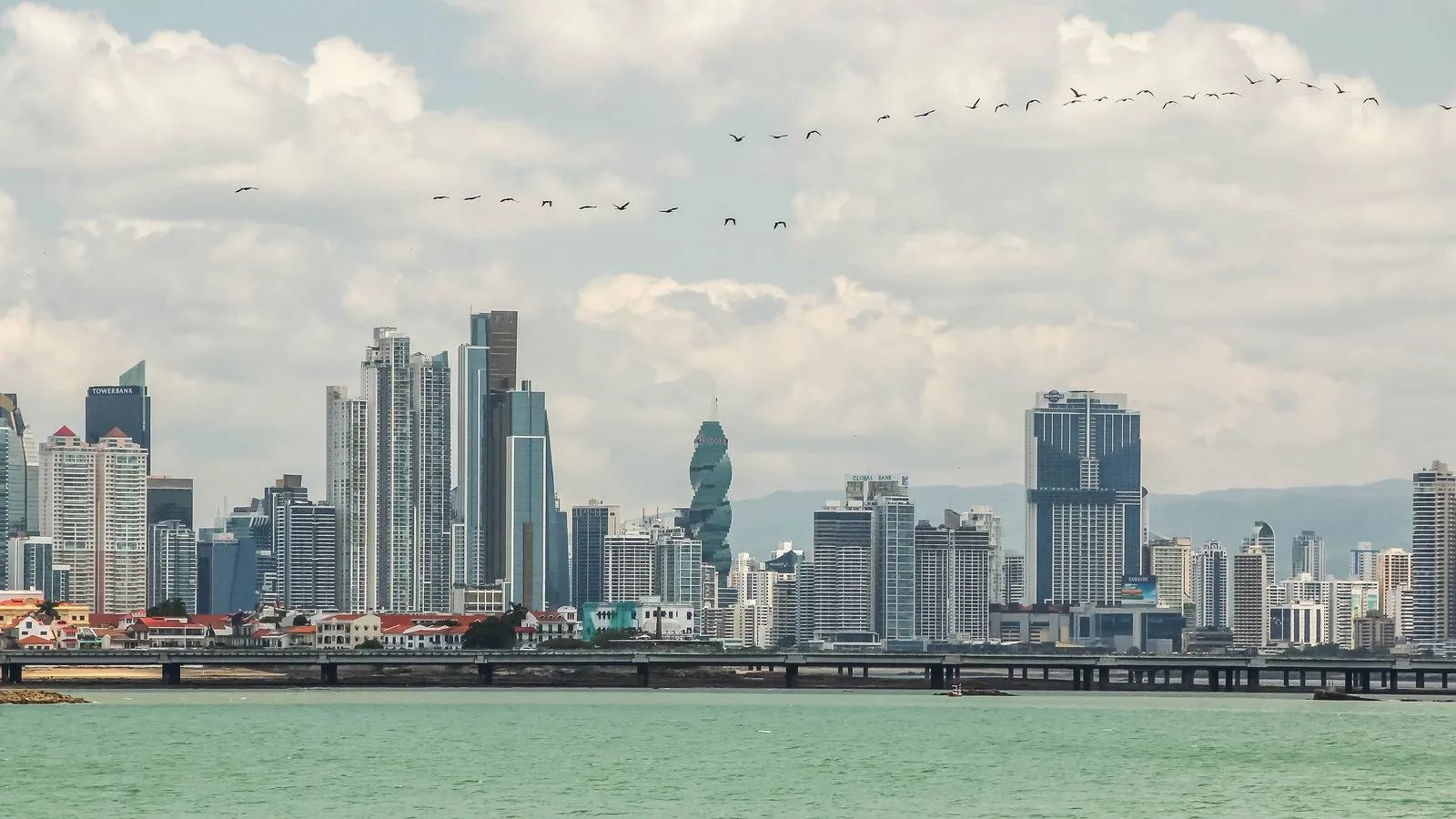
Cover photo: Panama City skyline across the bay. Photo by Dr. Thomas Liptak, Wikimedia Commons, CC BY-SA 4.0, cropped.